Wednesday, 24 June 2026

FT8 vs FT4: Choosing the Right Digital Mode for Weak Signal Success

The world of amateur radio has been revolutionized by digital modes, with FT8 and FT4 standing out as two of the most popular protocols from the creators of WSJT-X. Both are masterpieces of software engineering designed to facilitate contacts under challenging, weak-signal conditions. However, despite their similarities, they are optimized for different purposes.

FT8 vs FT4: Choosing the Right Digital Mode for Weak Signal Success


FT8 vs FT4: Choosing the Right Digital Mode for Weak Signal Success

Thursday, 4 June 2026

Master Ham Radio Guides & Tutorials

This page brings together in‑depth Ham Radio guides, tutorials, and how‑to articles from DXR Electronics Bits—covering SDR, DRM, propagation, digital modes, receivers, and practical operating techniques, without any news or project‑build posts. SDR, DRM & Reception Tutorials Receive DRM with HDSDR and DREAM Decoder Using RTL‑SDR Build a complete DRM receive chain with an RTL‑SDR 

Monday, 18 May 2026

Real-World Feedback: Navigating the zBitx v2 Issues and Upgrades

Real-World Feedback: Navigating the zBitx v2 Issues and Upgrades: Dive deep into the real-world performance, software bugs, and safety considerations of newly released zBitx v2 issues and feeback open-source SDR transceiver.

Tuesday, 12 May 2026

OXO QRP HF Transmitter

The OXO QRP HF transmitter is a simple, low-power CW (continuous wave) transmitter designed by George Burt, GM3OXX. It is a single-band transmitter that can be built to operate on any of the amateur radio bands from 160 to 20 meters. The transmitter is built around a few standard transistors and a crystal oscillator. It is an elementary circuit to build, and can be assembled from a kit or from scratch.

OXO-QRP-HF-Transmitter
Fig: OXO QRP HF Transmitter

The OXO transmitter is a QRP HF transmitter, which means that it produces a very low output power. This makes it ideal for making short-range contacts with other amateur radio operators. The OXO transmitter can also be used for experimentation and learning about radio electronics.

OXO QRP HF Transmitter

TL071 Audio Compressor Circuit

The TL071 operational amplifier makes an excellent foundation for DIY audio compressor circuits. This single-supply design TL071 Audio Compressor offers reliable dynamic range control for musical instruments and recording applications.

TL071 Mike Audio compressor

TL071 Audio Compressor Circuit:

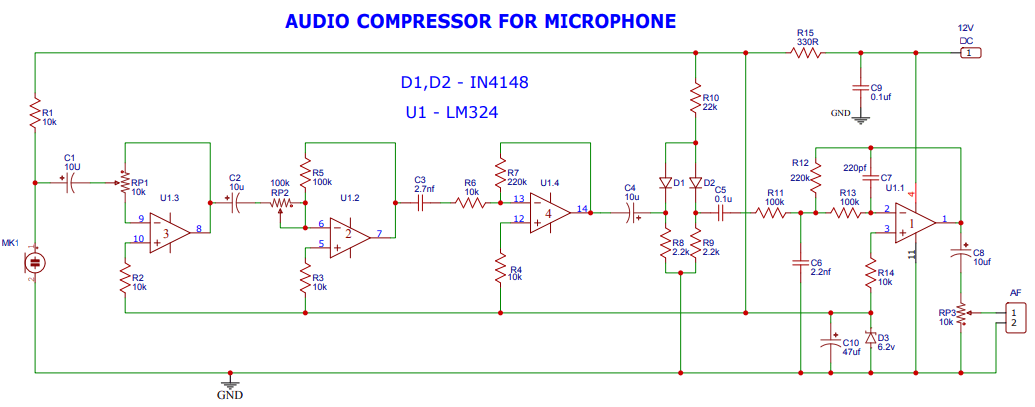
Audio compressor for microphone

This circuit diagram illustrates an audio compressor for microphone signals. Its primary job is to even out the volume of your voice, making soft sounds louder and loud sounds quieter, resulting in a more consistent and professional audio output. This is incredibly useful for podcasts, voice overs, amateur radio, or any application where microphone levels can fluctuate.

audio compressor for microphone used in SSB Transceivers
Audio compressor for microphone

Monday, 11 May 2026

Getting Started with AIS: Track Ships from Your Shack with a RTL-SDR

The Automatic Identification System (AIS) is a VHF radio-based collision-avoidance protocol that virtually every commercial, passenger, and large recreational vessel in the world is required to carry. Since 2004, the International Maritime Organization (IMO) has mandated AIS transponders on all ships of 300 GT or more engaged in international voyages, all cargo ships of 500 GT or more on domestic routes, and all passenger ships regardless of size.

AIS featured image

Every few seconds — sometimes as often as every two seconds when a vessel is manoeuvring — its AIS transponder transmits a compact digital burst on one of two dedicated VHF channels: 161.975 MHz (Channel 87B) and 162.025 MHz (Channel 88B). That burst contains a rich data payload: MMSI number (a unique vessel ID), ship name, call sign, IMO number, vessel type, dimensions, draught, destination, navigational status, GPS position, course over ground, speed over ground, rate of turn, and more.


Getting Started with AIS: Track Ships from Your Shack with a RTL-SDR

Complete Guide to Budget Software Defined Radio : From $15 Dongles to Serious HF Receivers

 Software Defined Radios have quietly rewritten the rules of radio listening. What once demanded a shelf full of dedicated hardware — separate receivers for HF, VHF, UHF, satellite — now fits into a USB dongle the size of your thumb. For hobbyists and shortwave listeners working on a tight budget, that shift is nothing short of revolutionary. This guide covers the full landscape of affordable SDRs: what to buy at each price point, which software tools matter, and how to avoid the traps that catch most beginners.

Friday, 8 May 2026

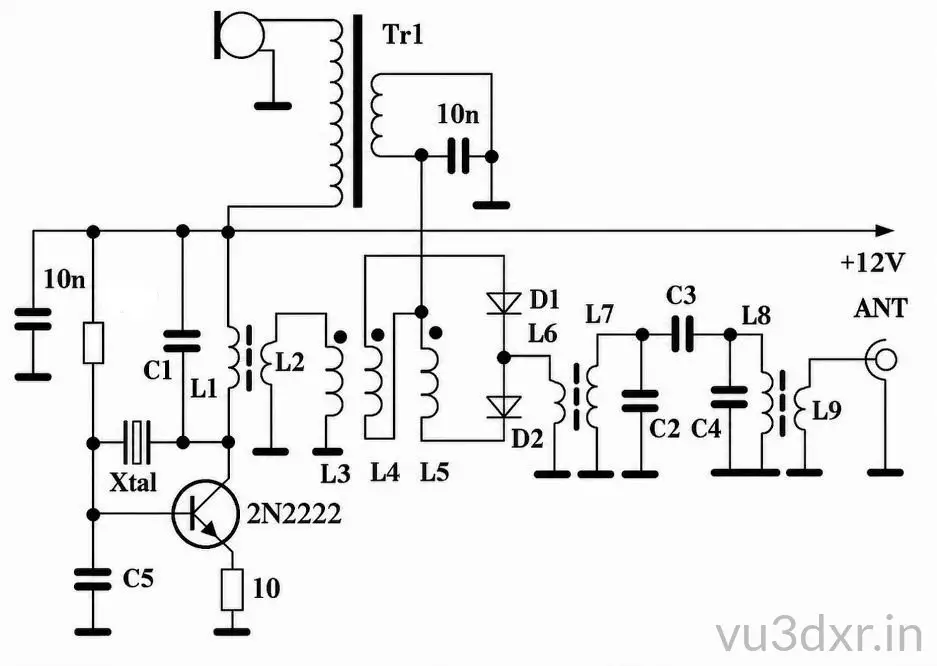
Building a Simple 2N2222 DSB Transmitter for Amateur Radio

Minimalist RF circuits often teach more than complex modern designs. This small DSB transmitter is a good example. The entire DSB transmitter uses only one active semiconductor device together with a pair of diodes and a few tuned circuits.

At first glance the circuit almost looks too simple to work seriously. Yet it does. When connected to a properly matched antenna, the transmitter can establish contacts with ordinary SSB stations surprisingly well. Most operators on the other end will hardly notice that the signal comes from such a basic setup because the carrier is largely suppressed.

The original concept was published by the well-known experimenter JF1OZL and later reproduced by several European homebrew enthusiasts. Its appeal comes from one thing: simplicity.

DSB Transmitter using 2N2222

Building a Simple 2N2222 DSB Transmitter for Amateur Radio

Thursday, 7 May 2026

ATS Mini Firmware Now Supports LILYGO T-Embed SI4732

ATS Mini Firmware Now Supports LILYGO T-Embed SI4732: ATS Mini firmware v2.34 now includes experimental support for the LILYGO T-Embed SI4732 receiver. Here is what the hardware does, how ATS Mini firmware works,

Monday, 27 April 2026

Twin-Lead J-Pole Antenna for VHF and UHF Amateur Radio

Want a simple, low-cost antenna that actually performs well on VHF/UHF? The twin-lead J-pole might be exactly what you need.

Built from basic 300-ohm twin-lead, this classic design combines a half-wave radiator with a quarter-wave matching section, giving you efficient performance without radials or complicated tuning networks.

Why it’s so popular among ham operators:
• Easy to build with minimal materials
• Naturally omnidirectional—great for repeaters and local contacts
• Adjustable feed point for low SWR without extra components
• Lightweight and portable—perfect for field setups or emergency kits

Whether you're experimenting with antennas or need a reliable backup for your station, this design delivers solid performance for its simplicity.

Check out the full build guide and dimensions here:
🔗 https://vu3dxr.in/twin-lead-j-pole-antenna-for-vhf-and-uhf-amateur-radio/

Full Wave Loop Antenna for VHF UHF FM Radio Bands

Looking to upgrade your VHF/UHF setup without complicated gear? Try building a full-wave loop antenna.

This design uses a loop with a perimeter equal to one wavelength, giving you better efficiency and a more balanced radiation pattern compared to basic antennas.

Why hams love it:
• Lower noise pickup (great for cleaner signals)
• Around 2 dB gain over a dipole
• Works across VHF, UHF, and even FM bands with simple scaling

It’s compact, easy to build, and surprisingly effective for both transmitting and receiving.

If you enjoy DIY radio projects, this guide walks you through dimensions and construction step by step:

🔗 https://vu3dxr.in/full-wave-loop-antenna-for-vhf-uhf-fm-radio-bands/

The zBitx v2 Migration: Community Fixes for v1 Hardware Owners

The zBitx v2 Migration: Community Fixes for v1 Hardware Owners: zBitx v2 Migration. Learn how to fix common white screen bug, calibrate your touchscreen, and ensure your Pico W is ready for the new Wi-Fi architecture

Simple CW 74HC240 Transmitter using buffer IC

Simple CW 74HC240 Transmitter using buffer IC: This is a simple but effective CW 74HC240 transmitter design using a octal buffer IC 74HC240 as the main component, operates at 7.023 MHz .

Monday, 20 April 2026

The zBitx v2 Has Arrived: Efficiency, Built-in EFHW, and a Wi-Fi Revolution

The zBitx v2 Has Arrived: Efficiency, Built-in EFHW, and a Wi-Fi Revolution: Discover the zBitx v2 by Ashhar Farhan (VU2ESE). Explore new hardware features like the built-in EFHW transformer, LDMOS power amplifier, and user interface.

Sunday, 19 April 2026

Khanfar Spectrum Analyzer: A Free RTL-SDR Tool Suite Worth Knowing

Khanfar Spectrum Analyzer: A Free RTL-SDR Tool Suite Worth Knowing: A detailed look at the Khanfar Spectrum Analyzer free RTL-SDR tools covering real-time FFT, wideband scanning, CFAR , IQ recording, and radio direction finding

Thursday, 16 April 2026

Build a Simple FM Band Transmitter Circuit

Build a Simple FM Band Transmitter Circuit: This simple FM band Transmitter circuit offers an excellent starting point for beginners can build this transmitter using common electronic components.

Want to build an FM transmitter from scratch? 🎙️📡

This simple circuit uses a single 2N2222A transistor and a 9V battery to create a functional FM band broadcaster. A great weekend project for learning about tank circuits and frequency modulation!

Schematic and build guide: https://vu3dxr.in/build-a-simple-fm-band-transmitter-circuit/

Mini FM Radio Transmitter

Mini FM Radio Transmitter: FM Radio Transmitter takes your voice from a microphone and turns it into a r signal. Then, this radio signal can be picked up by any standard FM radio nearby.

Build your own tiny radio station! 🎙️📡

This Mini FM Radio Transmitter circuit is a great way to learn about oscillators, tank circuits, and RF modulation. Simple components, 9V powered, and easy to tune.

Details and schematic here: https://vu3dxr.in/mini-fm-radio-transmitter/

Monday, 13 April 2026

DIY Moxon Rectangle Beam Antenna for 10m, 15m, and 20m Bands

DIY Moxon Rectangle Beam Antenna for 10m, 15m, and 20m Bands: Master the DIY Moxon Rectangle Beam antenna. Detailed guide on dimensions, design, and calculations for 14MHz, 21MHz, and 28MHz ham radio bands.

Sunday, 12 April 2026

Meshtastic Ham Radio Guide: LoRa Mesh Networking for Emergency and Everyday Use

If you’ve been hearing the buzz about Meshtastic but aren't sure how it fits into the Amateur Radio world, this comprehensive guide from VU3DXR is a must-read.

While some dismiss it as just for "preppers," hams worldwide are leveraging LoRa (Long Range) technology to build self-healing, infrastructure-independent mesh networks.

What’s inside the guide:The Tech: How LoRa achieves incredible range below the noise floor. ✅ The Hardware: A look at the T-Beam, Heltec, and RAK WisBlock. ✅ Meshtastic vs. APRS: Why Meshtastic is winning in areas with low infrastructure (like India). ✅ Ham Compliance: How to stay legal (callsign ID, disabling encryption, and frequency selection).

Whether you're in a disaster-prone area or just love experimenting with digital modes, it's time to see what LoRa can do for your shack.

📖 Read the full guide here: https://vu3dxr.in/meshtastic-ham-radio-guide-lora-mesh-networking-for-hams/