Saturday, 14 May 2011

W1FB 6M RF Preamp

image


Here is a schematic sent to me by W1FB many years ago. It is very similar to a 6M two-stage preamp that he published in QST in the mid eighties. Doug really favored the grounded gate FET for narrow band preamps. His published work is replete with examples of them on just about every band. I built that amp and remember getting about 10 dB gain, which is all that I wanted for the 6M direct conversion receiver using a diode ring detector that I was building. The great feature of the amp is that it combines a band pass filter and preamp in one. I lost the original schematic that Doug sent me but was delighted to see that I made a bitmapped drawing of it on a floppy disk that was recently re-discovered when we were moving an old desk. The shield shown in the schematic was a small piece of grounded ,double sided PC board in which, I made a small chamfered hole in to pass the lead going to the T2 tap. The shield, along with very short component leads will help minimize parasitic oscillations. The T2 tap is 3 turns down from the end of the T2 main winding that connects to the variable capacitor. Doug specified T37-10 cores for the inductors, but I substituted T37-6 cores and used the same number of windings as specified for the T37-10 core inductors. It worked fine.


http://www.qrp.pops.net/preamp.asp

How to make foxhole radio receiver (with no batteries)


Foxhole radio receiver or Crystal receiver is a form of radio that does not operate on local oscillator, which makes it hard to be detected by other electronic device. One of the most interesting thing of Foxhole radio is that it could be operated without the use of batteries, as it is powered solely by the radio waves through its long wire antenna.

Foxhole radio was (supposedly) popular during World War II because it enabled the GI to receive radio broadcast in the middle of the war, particularly in France as the Germans has outlawed the use of radio by civilians, thus the American GI need to build their own receiver to receive broadcasts. Typical component of foxhole radio during those days are : a period razor blade (not the newer galvanized one), carbon (obtained from pencil) and some copper wire with woodblock or cardboard as its base.


http://please.name.my/302/how-to-make-foxhole-radio-receiver-with-no-batteries.html

Tuesday, 22 March 2011

NiMH Battery Charger


Here is a simple battery charger for the Nickel Metal Hydride battery that requires current regulated charging. The charger provides 140 mA current for quick charging of the battery.Power supply section consists of a 0-18 volt AC 1 Ampere step-down transformer, a full wave bridge rectifier comprising D1 through D4 and the smoothing capacitor C1. Current regulation is achieved by the action of R1,R2 and the Epitaxial Darlington PNP transistor TIP 127. Resistor R1 keeps the charging current to 140 milli amperes. LED and resistor R2 plays an important role to control the base current of T1 and thus its output.


Around 2.6 volts drop develops across the LED which appears at the base of T1. Emitter – base junction of T1 drops around 1.2 volts. So 2.6 – 1.2 volts gives 1.40 volts. So the current passing through R1 will be 1.40 V / 10 = 0.14 Amps or 140 Milli Amps. The LED act as the charging status indicator. LED lights only if the battery is connected to the output of circuit and the input voltage is normal.

Read more: http://electroschematics.com/6073/nimh-battery-charger/#ixzz1HL7dzmz5

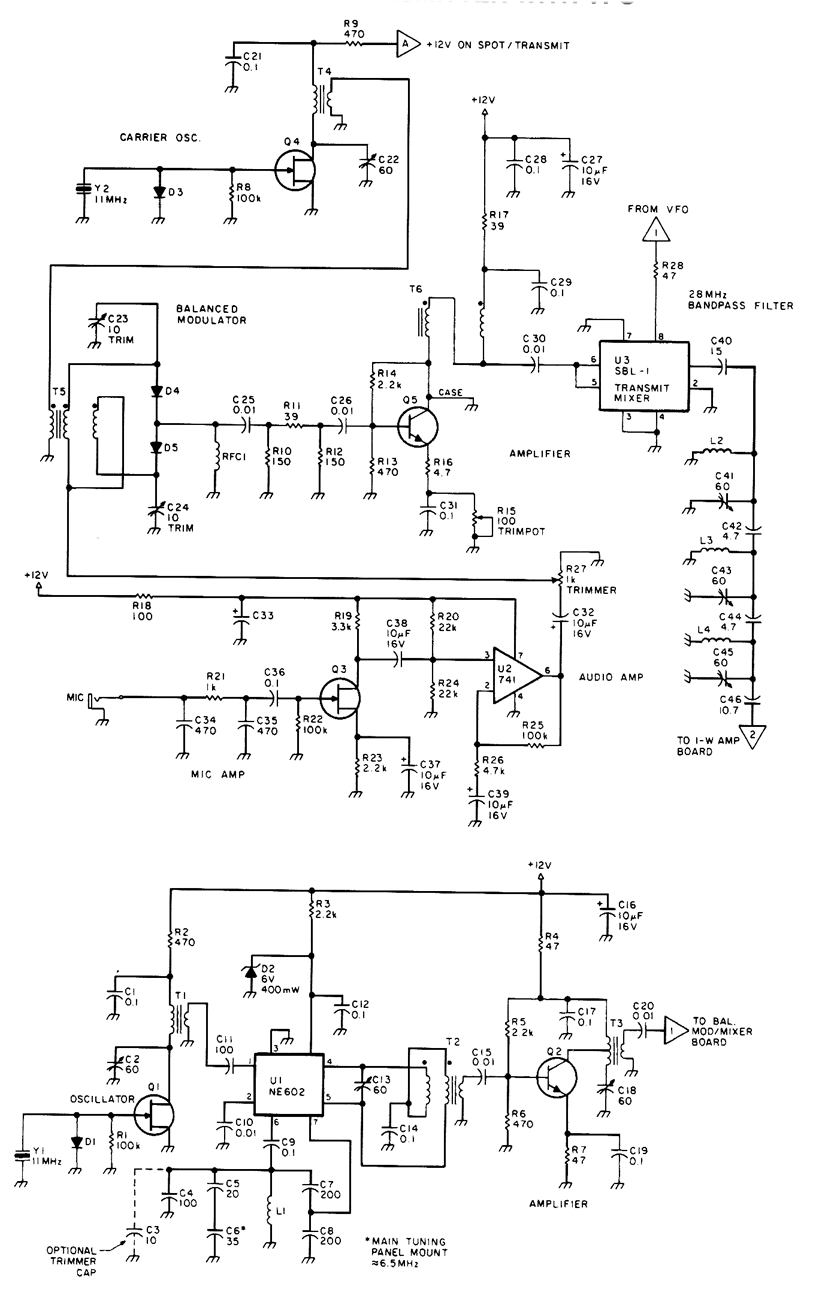
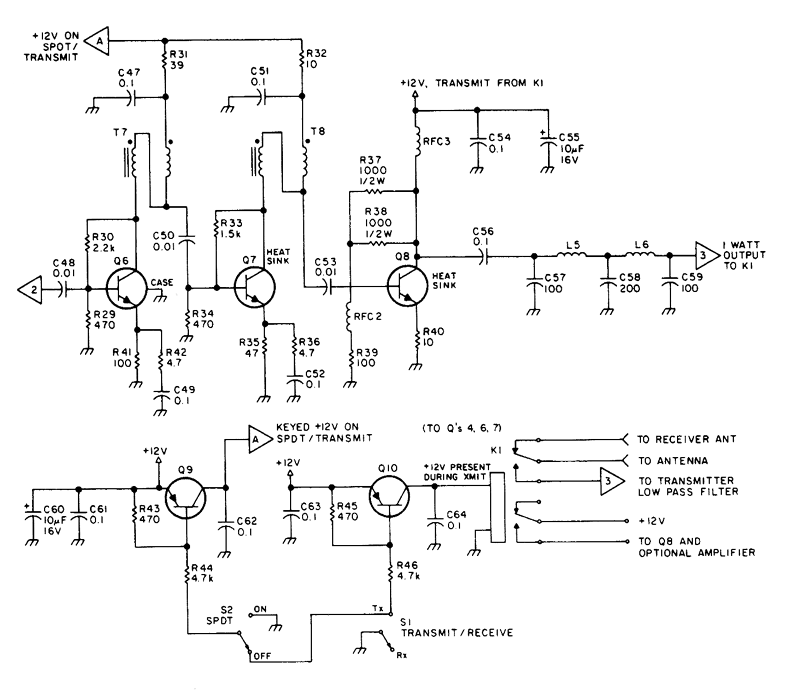
10-M DSB QRP TRANSMITTER WITH VFO


NE602 circuit : 10-M DSB QRP TRANSMITTER WITH VFO
NE602
NE602 circuit : 10-M DSB QRP TRANSMITTER WITH VFO
NE602
The three schematics represent three building blocks for a 10-meter SSB transmitter. Or these blocks can be used separately as circuit modules for other transmitters. The VFO board uses an FET transmittal oscillator, the VFO signal is mixed in an NE602 mixer and is amplified by Q2 to a level suf-ficient to drive an SBL-1 mixer in the transmit mixer stage (+7 to +10 dBm). In the balance mixer/modulator board, an 11-MHz crystal oscillator drives a diode balanced mixer. Audio for mod-ulation purposes is also fed to this mixer. The DSB signal feeds a 28-MHz BPR The 1-W amplifier board consists of a 3-stage amplifier and transmit/receive switching circuitry.